


The Psychology of Taqiyya
Understanding Deception in Ideology

The case of Taleb Alabdulmohsen, a 50-year-old who drove his car into a crowd at a bustling Christmas market in Magdeburg, Germany, on December 20, is far more unambiguous than it seems. Many attempts by the press to introduce "complexity" into the picture seem rather half-baked and distracting. These include baseless attempts to attribute this heinous act of terrorism to the far-right by labeling Taleb an ex-Muslim, an Elon Musk fan, and a voter of the German AfD Party. Predictably, the cacophony of "Islamophobia" accusations has been amplified in the aftermath. The consistent reluctance to confront the reality of incidents involving perpetrators from Islamic demographics frustrates the public, cultivating a pervasive sense of insecurity and betrayal.
Taleb targeted German Christians explicitly. While the controversy surrounding his contradictory social media posts raises questions about his mental stability and ideological convictions, his calculated act of terrorism challenges the "Islamophobia" narrative.
As a Saudi-born refugee, Taleb brutally murdered five innocent individuals, including a 9-year-old boy, and inflicted injuries upon 235 others. He arrived in Germany in 2006, claiming to be a persecuted ex-Muslim, and was granted refugee status in 2016. According to Saudi officials, Taleb fled his homeland to evade charges of rape, human trafficking, and terrorism.
On his X account, he presented himself as a psychiatrist and founder of a Saudi rights movement. However, an article by N-TV revealed him to be a con artist masquerading as a medical professional. Taleb was employed as a psychiatrist specializing in the rehabilitation of addicted offenders at a state-owned psychiatric hospital in Bernburg, near Magdeburg. According to the Mitteldeutsche Zeitung, his colleagues distrusted him and even mockingly called him "Dr. Google" due to his reliance on online resources for diagnoses. He allegedly prescribed medications that could have endangered patients' lives—disasters were averted only through the intervention of vigilant nurses. Staff also reported that when patients sought advice on overcoming drug addiction, Taleb offered bizarre recommendations, such as drinking alcohol and avoiding honey. Yet, the clinic management dismissed all the complaints.
Taleb's social media footprint is a labyrinth of contradictions. He posted numerous anti-Islam tweets while concurrently sending wicked threats to ex-Muslim individuals and organizations. Several recipients of these threats accused him of harassment and stalking. Moreover, he operated an Arabic-language website that offered fraudulent asylum advice, including instructions on how to feign being gay or ex-Muslim. These activities corroborate the Saudi authorities' human trafficking accusations against Taleb. The Saudi Ministry of Foreign Affairs informed German authorities of Taleb's criminal background and extremist inclinations, issuing four "Notes Verbal" to intelligence agencies and the German foreign ministry. According to the Saudis, no response was received, and repeated extradition requests were summarily snubbed. One of Taleb's female victims, who is a Saudi Ex-Muslim, warned German authorities about his plans for mass killings of Germans, but tragically, her warnings were ignored, too.
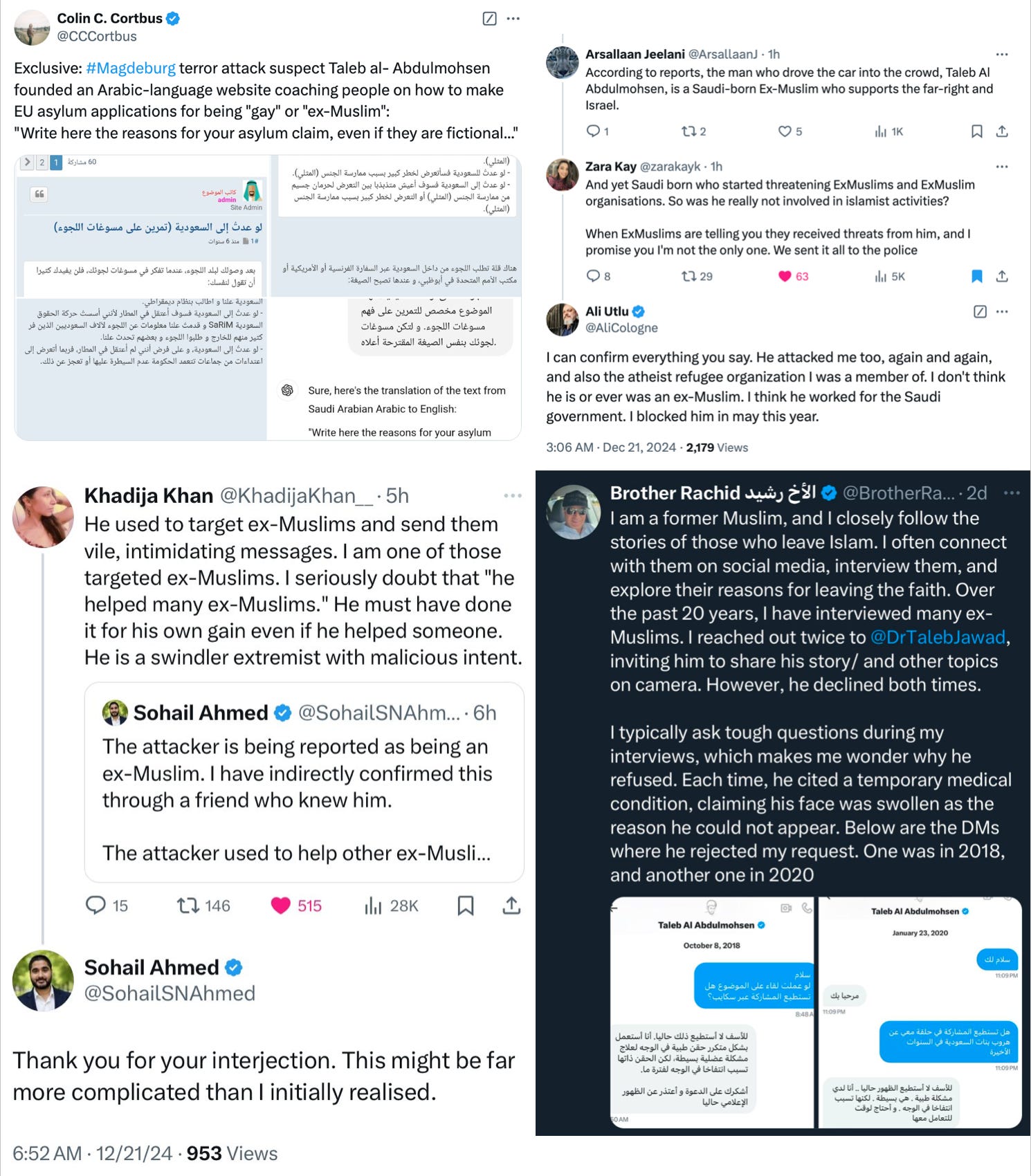
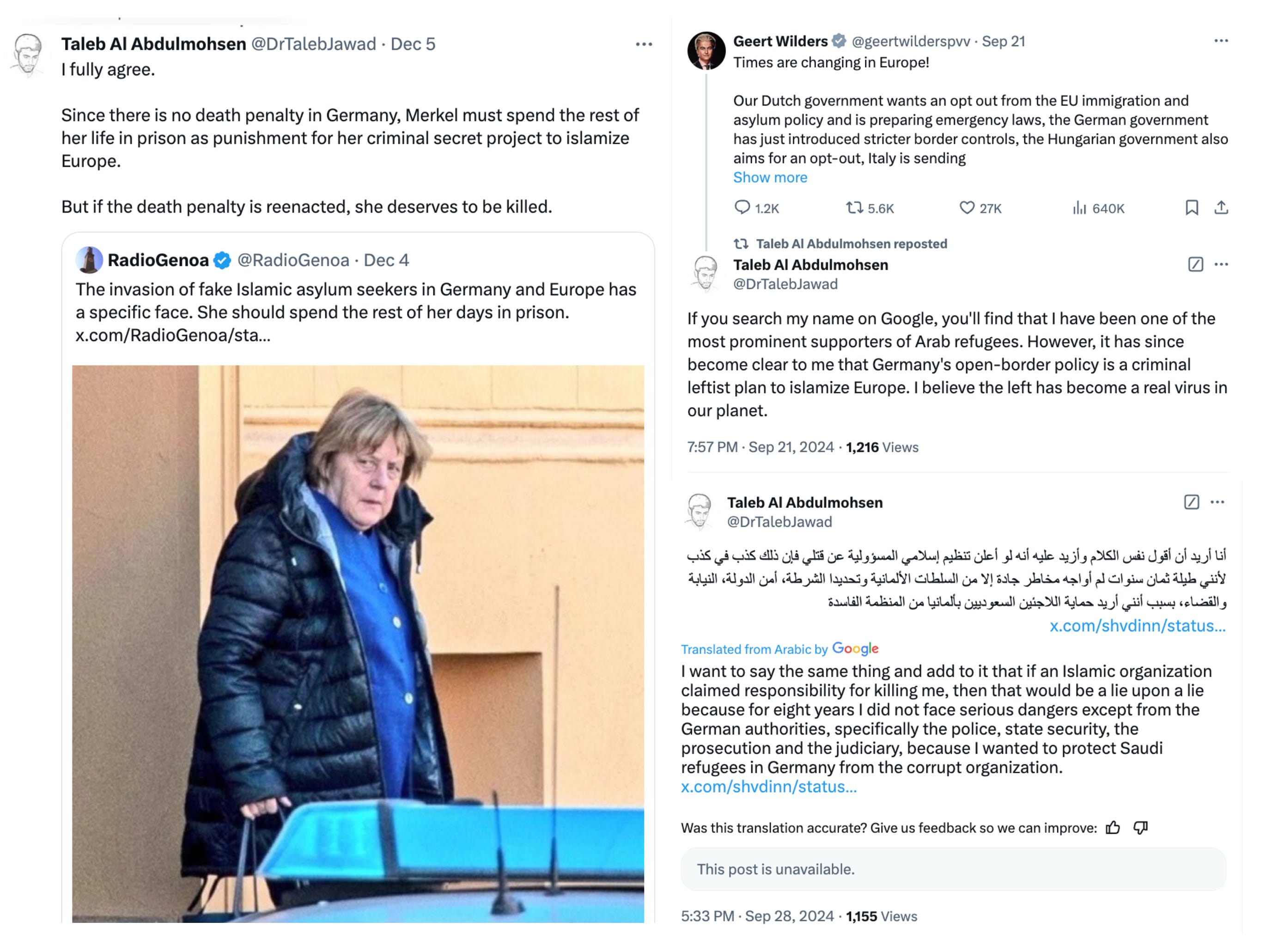
In a 2016 tweet, Taleb identified as a Shia Muslim and described Wahhabism as the "original Islam." Later, he promoted the Islamic Regime of Iran's "One-State Solution," praising Iran as the true leader of "resistance" against Israel, insinuating that Sunni groups like ISIS and Hamas were proxies for Israel. His rhetoric echoes the typical propaganda of the Ayatollah regime, which seeks to position itself as morally superior to Sunni Arab states.
By promoting Wahhabism as the "original Islam" and exhibiting a propensity for Shia-centric Iranian regime rhetoric, Taleb manifests a paranoid compulsion to "uncover" hidden truths, consistent with his psychological profile as a radical operating under a false flag.


Islam can appear paradoxical to non-Muslims: it is often called a religion of peace, yet its adherents are frequently linked to global terror attacks. While the Qur’an discourages believers from deceiving one another—“surely God guides not him who is prodigal and a liar”—it permits deception toward non-Muslims under certain conditions, known as Taqiyya.
The Qur’an illustrates this principle with contradictory verses juxtaposing peace and violence. Verse 3:28 explicitly permits deception towards non-Muslims: “Let believers [Muslims] not take infidels [non-Muslims] for friends and allies instead of believers … unless you guard yourselves against them, taking precautions.”
Taqiyya has two primary applications. Historically, it allowed Shia Muslims to conceal their faith to avoid persecution by Sunni rivals. Conversely, Sunni Muslims have used Taqiyya as a strategy of active deceit during jihad, emphasizing it as a doctrinally approved tool. In Islamic tradition, such deceit is sometimes portrayed as equal or superior to other military virtues, including courage and self-sacrifice.
In his book At-Taqiyya fil-Islam (Dissimulation in Islam), Sami Mukaram, a former Islamic studies professor at the American University of Beirut, emphasizes the centrality of Taqiyya in Islamic doctrine and practice. He notes, “Taqiyya is of fundamental importance in Islam. Practically every Islamic sect agrees to it and practices it … Taqiyya is very prevalent in Islamic politics, especially in the modern era. This underscores its widespread acceptance as a mainstream practice, deeply embedded in historical and contemporary Islamic politics.”
The Magdeburg car attack is a convergence of ideological manipulation, mental instability, and systemic societal failures. While Taleb’s anti-Islamic online persona complicates the narrative, his choice of target and behavior point to Islamist extremism. The attack primarily harmed German Christians and discredited genuine ex-Muslims, with Muslims being the least affected group.
His scheming behavior, such as posing as a psychologist, his fraudulent website, and his desire for attention—evident in his public threats and calculated use of violence— point to narcissistic traits. His lack of empathy, readiness to harm innocents, and long-term planning align with antisocial personality disorder (ASPD) or psychopathy. He solicited input from his followers regarding his violent intent through polls posted on X, indicating that his attack was meticulously planned over an extended period.
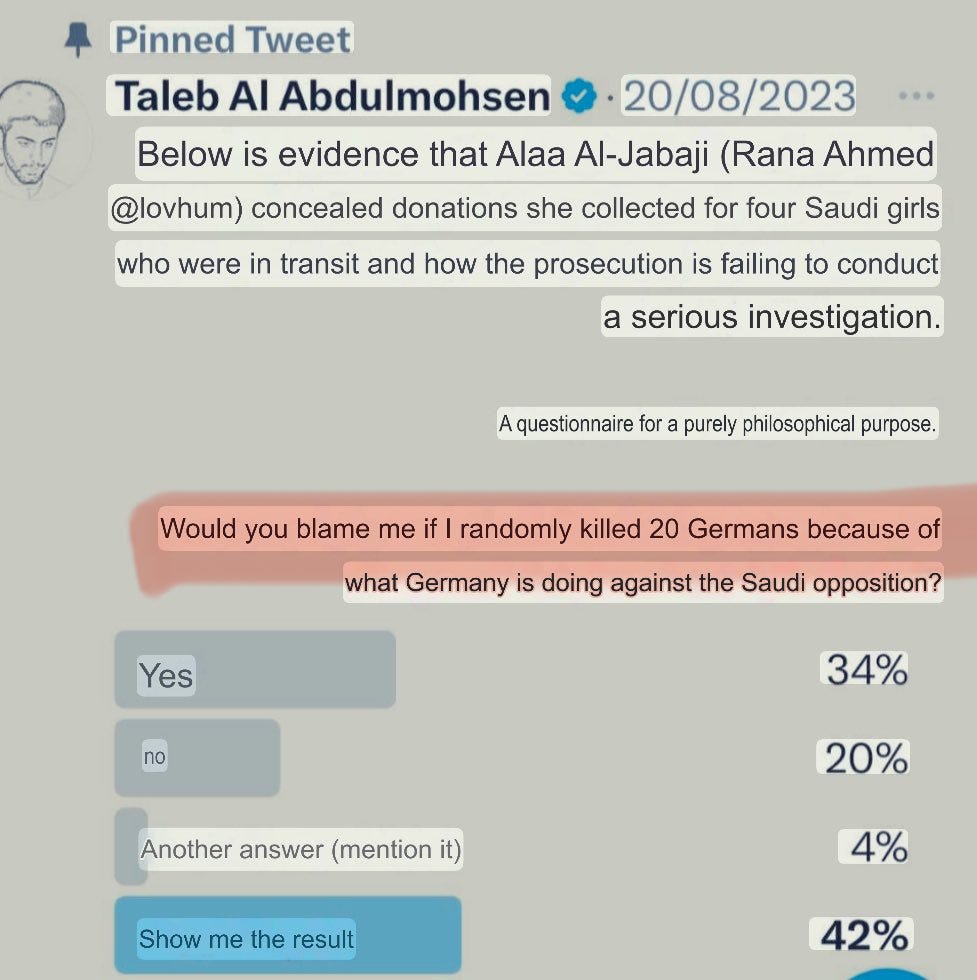
By targeting a Christmas market—a powerful symbol of German and Christian identity—Taleb Alabdulmohsen intentionally sought to provoke societal outrage. Yet, whether or not he was practicing Taqiyya, our focus should remain on the Elephant In The Room: the pathological ideologies and doctrines within the Islamic world that produce radicals like Taleb. Moreover, the German authorities' failure to act on repeated warnings unveils a systemic breakdown that allowed this tragedy to unfold.
How many times does the world has to be fooled before they realize they have been played? I am having hard time fathoming the gullibility of the West especially. No ideology should be pursued so blindly, willingly and stupidly when your own survival is at stake.
Very small % of people understand teaching of Koran and fall for narratives of a peaceful religion